Role: Lead UX Strategist, Truematter
Year: 2025
Focus: UX Strategy
Project Type: Research and Discovery
Key Outcome
Scope clarified and reduced
Overview
The client, a retail leasing company, had observed growing engagement from shopper users on their corporate website, which primarily served leasing-focused visitors. The challenge was determining how (or if) the site should evolve to support shoppers without compromising the needs of its core audience.
As part of a large-scale initiative to modernize this decade-old website—updating its codebase, upgrading underlying technology, and preparing it for long-term scalability—I led the strategy definition phase of the project to inform product direction for the redesign.
Product & Business Problem
Expanding scope to support a new user group introduced meaningful risk: added complexity, slower delivery, and the possibility of overbuilding without clear value.
Early on, we needed to answer:
- What do shopper users actually need from this site?
- How do those needs differ from leasing-focused visitors?
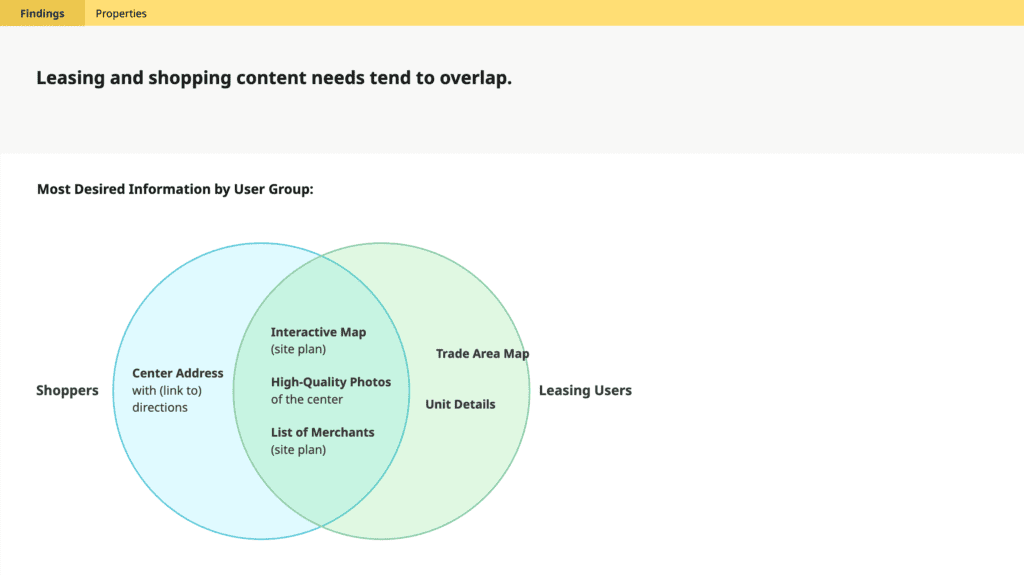
- Where do the needs of these audiences overlap?
- What level of investment was justified during the rebuild?
The goal of this project phase was to reduce uncertainty and produce clear, evidence-based recommendations to guide the next stage of the project.
My Role
I led the strategy definition phase end-to-end and was accountable for:
- Defining the overall discovery approach
- Planning and sequencing multiple research efforts
- Leading a design sprint focused on shopper users
- Conducting research focused on leasing-focused visitors
- Synthesizing findings across both audiences
- Translating insights into actionable product and experience recommendations
I proposed the stage activities to leadership (and received approval), incorporated the stage activities into the project statement of work, presented stage plans to the client, and partnered closely with client marketing and IT stakeholders throughout the project.
Strategy Definition Approach
To balance speed with rigor, I structured the work around two complementary discovery streams, each focused on a different user group:
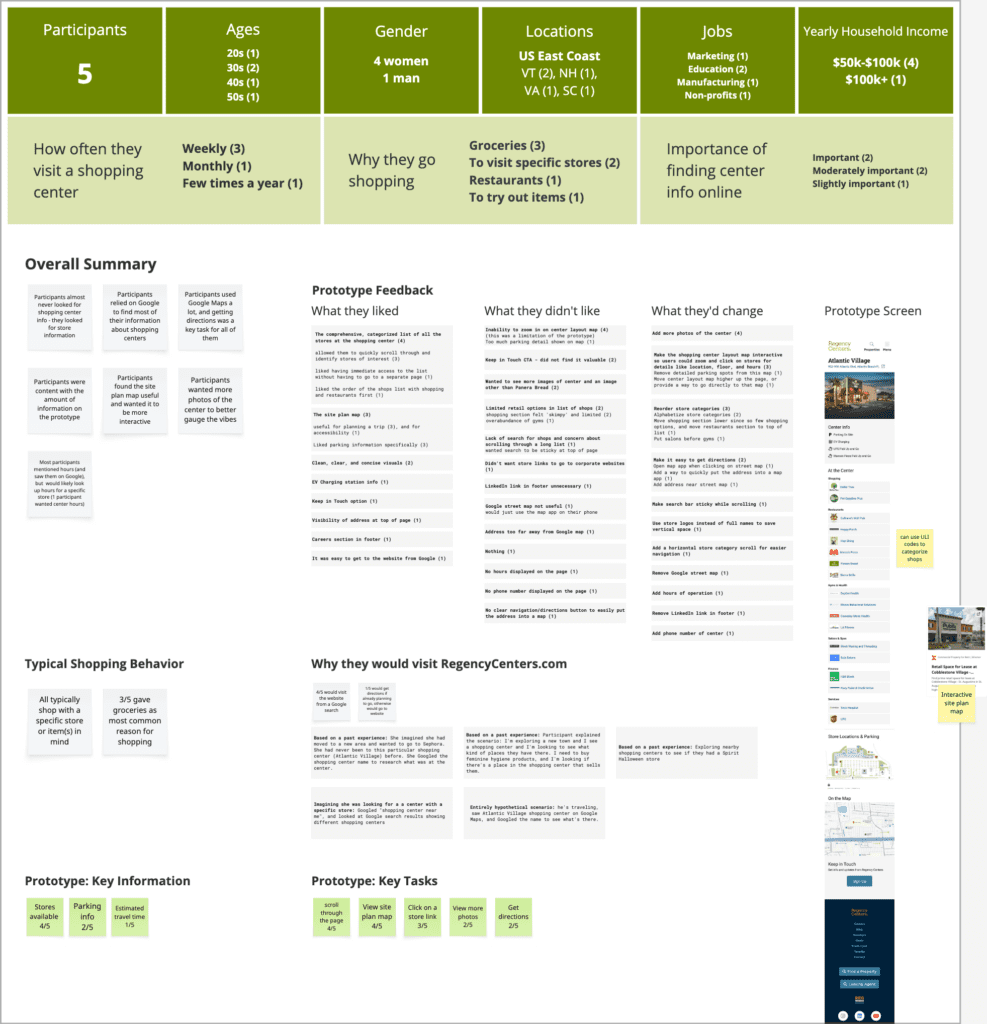
- Discovery Sprint (Shopper-Focused)
I led a condensed discovery design sprint adapted from the Design Sprint methodology, including collaborative stakeholder sessions, rapid prototyping, and usability testing with shopper users. - Supporting Research (Leasing-Focused)
In parallel, I conducted research in the form of usability testing, interviews, and surveys with the site’s core leasing audience to understand their needs, expectations, and critical workflows.
Synthesizing these research inputs allowed me to evaluate product direction through the lens of both current (leasing) and emerging (shopping) users.
Outcomes & Impact
Bringing together insights from both research streams, my team and I created a unified set of recommendations for the website redesign. While the sprint confirmed that a shopper-focused experience was usable and understandable, it also showed that shoppers needed less dedicated content and complexity than initially assumed. Interviews and surveys uncovered that shopper user needs overlapped with those of leasing-focused visitors.
As a result:
- Extensive shopper-only content was deprioritized
- Redesign scope was clarified and reduced
- Shared user needs were emphasized
- The team avoided unnecessary feature development
These data-backed recommendations directly informed planning for subsequent project stages and helped the rebuild move forward with greater focus.
Reflection
This phase demonstrated the value of structured discovery as both a product strategy tool and a risk-reduction mechanism. By integrating insights across multiple user groups, we replaced assumptions with evidence and aligned stakeholders around a clear direction. In future iterations, I would expand shopper testing to further validate edge cases, but this work successfully established a strong foundation for delivery.